


The ₹2 Decision That Costs More Than You Think
It starts with a simple calculation.
A retailer compares packaging options and chooses conventional plastic saving ₹2 per bag. On paper, it’s a smart decision. Multiply that across thousands of units, and the savings seem substantial.
But a few months later, something shifts.
Customers begin to notice. A competitor switches to eco-friendly / compostable packaging and highlights it across their branding. Social media conversations pick up. Questions arise: “Why is this brand still using plastic?”
Gradually, the ₹2 saved per bag begins to cost far more in customer trust, brand perception, and long-term growth.
This is the hidden reality many businesses overlook. Plastic packaging may appear inexpensive upfront, but its true cost extends far beyond the purchase price.
The Illusion of Low Cost
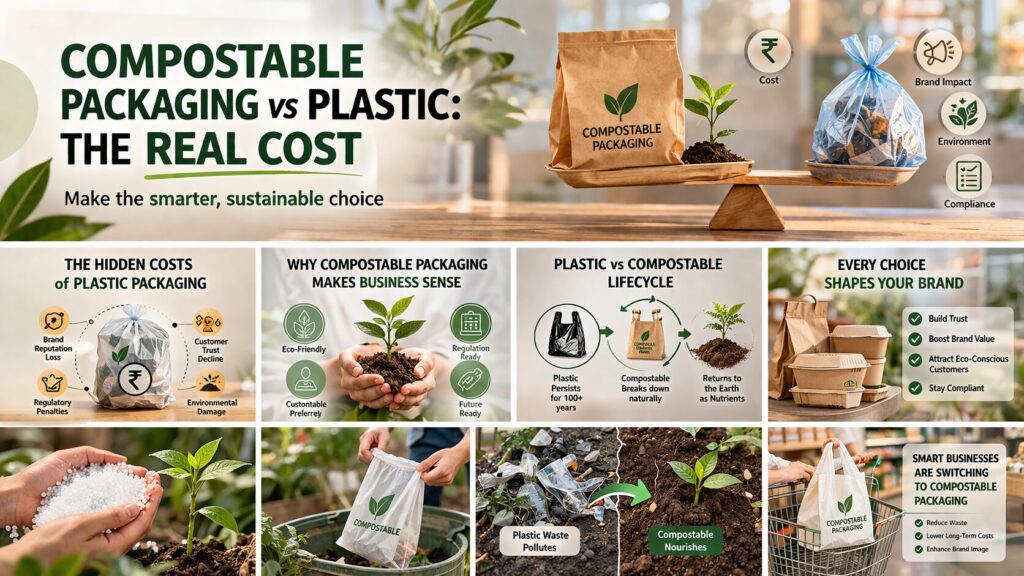 At first glance, conventional plastic packaging seems like the most economical choice. It is widely available, easy to use, and cheaper per unit compared to sustainable alternatives.
However, this perspective focuses only on short-term cost, ignoring the broader business impact.
What businesses often miss is that packaging is no longer just a functional requirement it is a visible representation of brand values. Every bag, wrapper, or mailer becomes part of the customer experience.
And today’s consumers are paying attention.
The Cost to Brand Reputation
Modern consumers are increasingly environmentally conscious. They are not just buying products—they are choosing brands that align with their values.
When a business continues to use conventional plastic packaging, it risks being perceived as:
- Outdated
- Environmentally irresponsible
- Out of touch with current expectations
On the other hand, brands that adopt sustainable packaging signal responsibility, innovation, and forward thinking.
A single negative perception may not seem significant, but over time, it shapes how customers talk about and remember a brand.
Reputation, once lost, is far more expensive to rebuild than the cost of switching packaging.
The Shift in Consumer Buying Behavior
Sustainability is no longer a niche preference it is becoming a mainstream expectation.
Consumers today:
- Prefer brands that reduce plastic waste
- Are willing to switch to eco-conscious alternatives
- Often share and promote sustainable brands on social media
This means packaging directly influences purchasing decisions.
A business that sticks with cheap plastic may unknowingly:
- Lose potential customers
- Reduce repeat purchases
- Miss out on organic word-of-mouth marketing
In contrast, sustainable packaging can act as a silent marketing tool, reinforcing brand values without additional advertising spend.
Regulatory and Compliance Risks
Governments across the world and especially in India are tightening regulations on single-use plastics.
Businesses relying on conventional plastic packaging face:
- Sudden policy changes
- Compliance costs
- Potential fines or restrictions
India has already implemented multiple phases of plastic bans, and further restrictions are expected as sustainability becomes a national priority.
Switching reactively, under pressure, is always more expensive than transitioning strategically.
Environmental Cost Becomes Business Cost
Plastic waste is no longer an abstract environmental issue it is a visible, growing problem.
From overflowing landfills to polluted waterways, the impact of plastic is increasingly tied to corporate responsibility.
Consumers, investors, and even partners are beginning to hold businesses accountable.
This means environmental impact is now directly linked to:
- Brand credibility
- Investor perception
- Long-term viability
What was once considered an “external” cost is now a core business factor.
The Hidden Marketing Opportunity You’re Missing
Every piece of packaging is a branding opportunity.
Yet, conventional plastic packaging does nothing to enhance brand value it is neutral at best and negative at worst.
Sustainable packaging, on the other hand:
- Communicates purpose
- Enhances unboxing experience
- Encourages customer sharing
- Differentiates the brand in a crowded market
In a world where customer attention is limited, even small details like packaging can influence perception.
Choosing cheap plastic means missing out on a powerful, built-in marketing channel.
Short-Term Savings vs Long-Term Value
Let’s revisit that ₹2 saving.
On a spreadsheet, it looks efficient. But when you factor in:
- Lost customers
- Reduced brand loyalty
- Missed marketing opportunities
- Regulatory risks
…the equation changes completely.
What seems like a cost-saving decision becomes a value-losing strategy.
Forward-thinking businesses are no longer asking:
“What is the cheapest packaging option?”
They are asking:
“What packaging creates the most value for our brand?”
The Smarter Alternative: Compostable Packaging
This is where compostable packaging changes the equation.
Unlike conventional plastic, certified compostable packaging is designed to:
- Break down naturally under composting conditions
- Leave no harmful residues
- Align with sustainability goals and regulations
For businesses, this means:
- Stronger brand positioning
- Improved customer perception
- Future-ready compliance
- Contribution to a circular economy
Companies like Bio-Plastobag are helping businesses make this transition seamlessly by offering certified compostable solutions tailored to different industries—from retail and e-commerce to food and agriculture.
Rethinking the Definition of “Cost”
 The real question is no longer whether plastic packaging is cheap.
The question is: what is it truly costing your business?
In today’s market, every decision especially visible ones like packaging shapes how your brand is perceived.
The ₹2 you save today could cost you:
- Customer trust tomorrow
- Market relevance in the future
- And growth opportunities in the long run
Sustainable packaging is not just an environmental choice it is a strategic business decision.
And the businesses that recognize this early are the ones that will lead tomorrow.
If you’re evaluating your packaging choices, now is the time to look beyond upfront costs.
Explore how compostable packaging solutions from Bio-Plastobag can help you reduce environmental impact while strengthening your brand.
Because the smartest investment isn’t the cheapest option it’s the one that delivers lasting value.